
Locktime
Size
4 bytes
Format
Little-Endian
Description
The block number or timestamp at which this transaction is unlocked.
Example
00000000Byte Visualization
The locktime field is a 4-byte value that specifies the earliest time a transaction can be added to the blockchain.
Let's examine our transaction to understand this better:
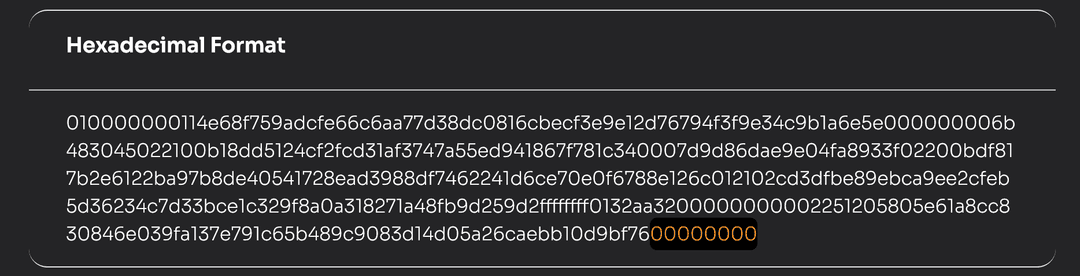
In our example transaction, we can see the locktime value is 00000000. This means:
- The transaction is valid immediately (can be included in the next block)
- No timelock restrictions are applied
- This is the most common locktime value used in Bitcoin transactions
Locktime Values
The interpretation of the locktime value depends on its range:
| Locktime Value | Interpretation |
|---|---|
0 | Transaction is valid immediately (most common) |
< 500.000.000 | Interpreted as a block height |
≥ 500.000.000 | Interpreted as a Unix timestamp |
For example:
- Locktime of 650000 means the transaction is invalid until block 650000
- Locktime of 1640995200 means the transaction is invalid until January 1, 2022 (Unix timestamp)
Note
Locktime is only enforced if at least one input has a sequence number below 0xffffffff. If all inputs have sequence 0xffffffff, the locktime is ignored.
Implementation Example
Here's how you might parse a transaction's locktime:
def parse_locktime(raw_tx: bytes, offset: int = 0) -> tuple[int, int]:
  """
  Parse locktime from raw transaction bytes

  Args:
      raw_tx: Raw transaction bytes
      offset: Starting position in bytes

  Returns:
      (locktime, new_offset)
  """
  # Read 4 bytes for locktime
  locktime_bytes = raw_tx[offset:offset + 4]

  # Convert to integer (little-endian)
  locktime = int.from_bytes(locktime_bytes, 'little')

  return locktime, offset + 4
Use Cases
1. Time-Delayed Transactions
Locktime can be used to create transactions that only become valid in the future:
def create_future_tx(block_height: int) -> bytes:
  """Create a transaction valid only after specific block height"""
  tx = Transaction()
  # ... add inputs and outputs ...

  # Set locktime to future block
  tx.locktime = block_height

  # Must set sequence < 0xffffffff for locktime to be enforced
  for tx_in in tx.inputs:
      tx_in.sequence = 0xfffffffe

  return tx.serialize()
2. Escrow Transactions
Locktime can be used in escrow services where funds should only be released after a certain time:
def create_escrow_tx(release_time: int) -> bytes:
  """Create a transaction that releases funds at specific time"""
  tx = Transaction()
  # ... add inputs and outputs ...

  # Set locktime to future timestamp
  tx.locktime = release_time

  # Enable locktime enforcement
  for tx_in in tx.inputs:
      tx_in.sequence = 0xfffffffe

  return tx.serialize()
Historical Note
Locktime was originally intended to be used with sequence numbers for
"high-frequency trades" - a way to update transactions before they were mined.
However, this design was vulnerable to miner manipulation and was later replaced by better payment channel designs like the Lightning Network.
Validation Rules
When validating a transaction with locktime:
- If all input sequences are 0xffffffff, locktime is ignored
- Otherwise:
- If locktime < 500000000: Compare against current block height
- If locktime ≥ 500000000: Compare against median time past (MTP)
- Transaction is invalid if current time/height is less than locktime
Warning
Using locktime for time-sensitive applications requires careful consideration of block time variance and potential network reorganizations.